
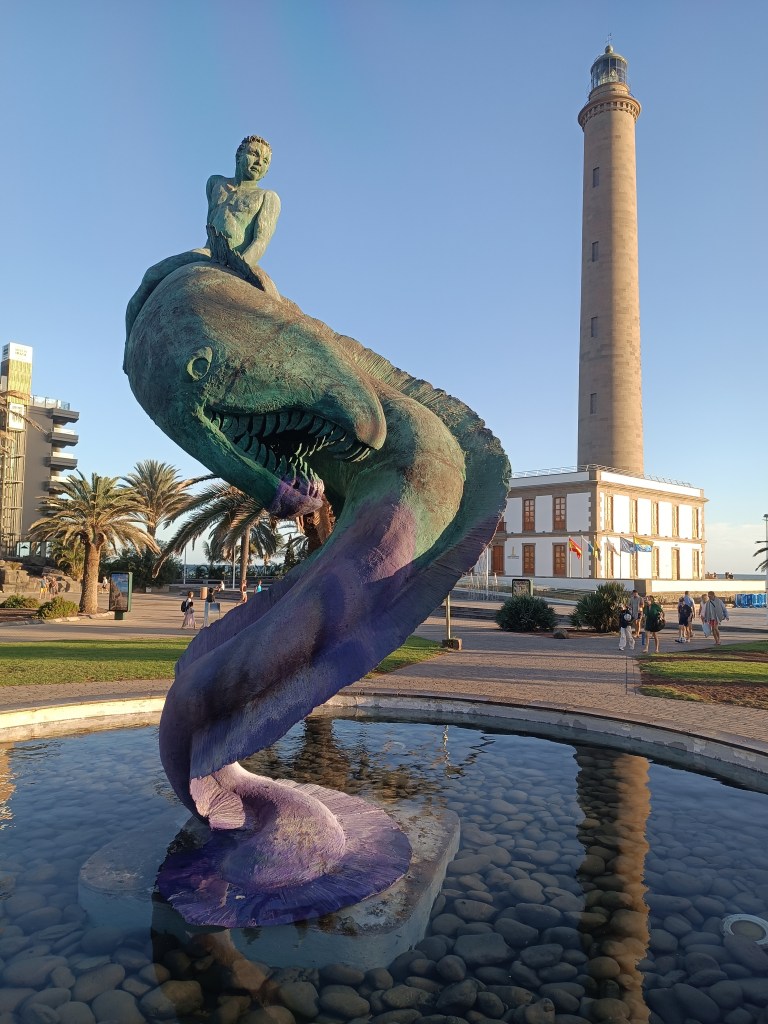
Since antiquity, it has been well known that black moray eels (specifically the Muraena augusti) dwell in the shallow waters of the Canaries. We call them ‘morenas’, and one is precisely the subject of the sculpturesque fountain next to the Faro de Maspalomas.
A clear inspiration for this work is the painting La Noche (The Night), from Néstor de La Torre’s famous series Poema del Atlántico. We will talk more about Néstor de la Torre and his works in Chapter 5, but suffice it to say he is one of Gran Canaria’s foremost artists. La Noche depicts a terrified boy riding a hideous marine creature as it splashes out of the ocean under the full moon. You will stumble upon a huge replica of this painting in Chapter 9.
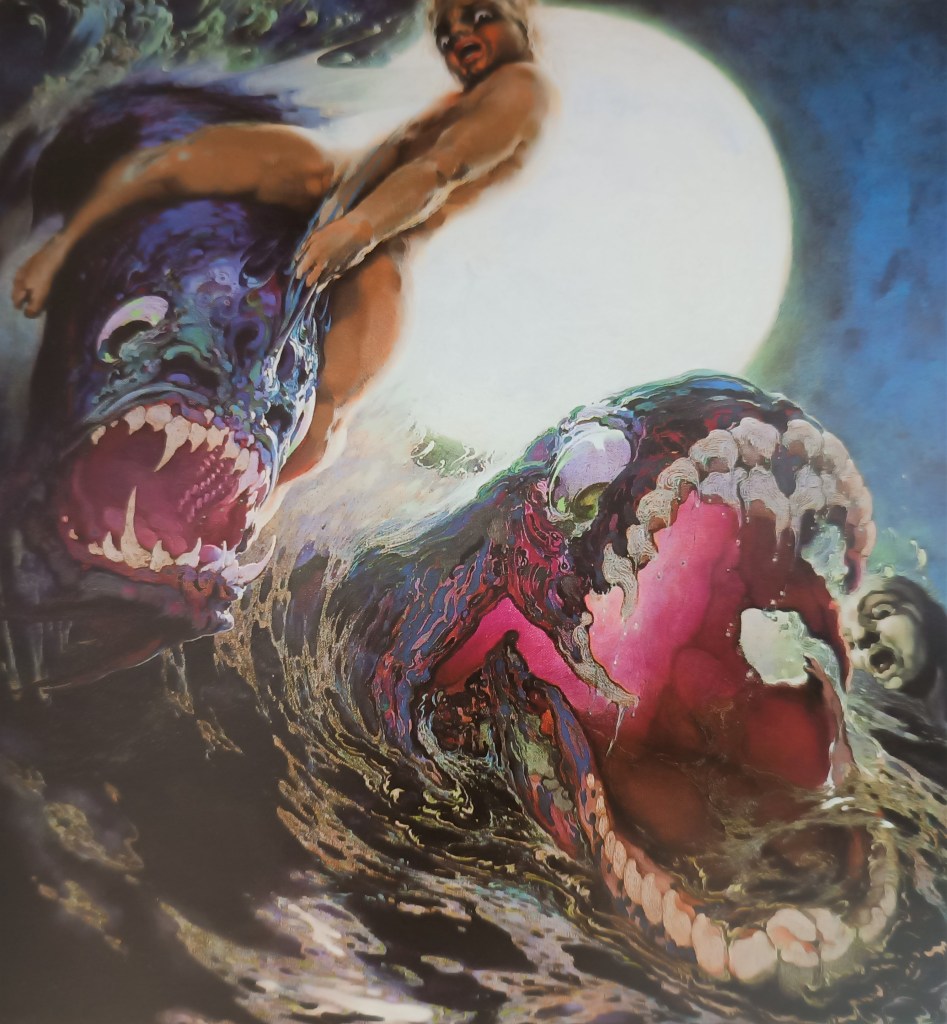
When asked casually about the painting, the one detail most locals recall is the “morena’s huge mouth and fearful, jagged teeth” almost jumping out of the frame to devour the viewers. I have heard ‘amateur’ tour guides in the south of Gran Canaria noting the similarity between Néstor’s morena and the morena in the Maspalomas fountain, going as far as to claim that the second is an attempted replica of the first.
The main issue with that claim is that the marine creature in Néstor’s painting is not a morena. Morenas have pointier heads and thinner, needle-like teeth. Néstor himself never identified the fish, and my Néstor book only refers to it as a sea-monster.
Still, given the morenas’ fearsome appearance and perceived aggressiveness, it is only natural that most locals wrongly recall Nestor’s menacing creature as a morena. Perhaps that is what makes the Maspalomas sculpture so pleasing to watch. The artist, in his homage to Néstor, chose to represent the fish in our collective memory, the fish that should be, rather than the fish that was. In doing so, he demonstrated a keen sensibility of our culture.
Either that, or this is a Canarian case of the Mandela Effect.
(Picture: The Morena fountain by Spanish artist Benito Valladares)
 The Fire Demon